Seven of Wands
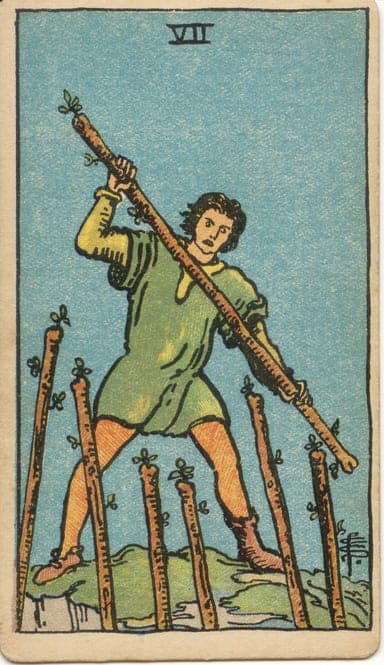
The Seven of Wands is the card of one man on a height fending off six staves raised from below. Readers traditionally take it as standing your ground, and Waite gives it valor, wordy strife and holding a position against competition.
- Suit
- Wands (Minor Arcana)
- Golden Dawn
- Mars in Leo
- Upright
- standing your ground, challenge, conviction
- Reversed
- overwhelm, giving up
Upright
High ground gives the defender an edge, even when he is outnumbered. Readers see conviction under pressure: defending a decision, a position or a set of values against people who push back. The card appears around debates, negotiations and competitive fields. It suggests there is something worth protecting and a real advantage in holding on.
Reversed
Overwhelm is the key word here. Readers take the reversed Seven as a defender tiring, giving up ground or wondering whether the fight is worth it. Sometimes it points to spreading effort too thin, and it prompts a question about which positions actually matter.
In love and at work
Holding a boundary with a partner, or defending a relationship against outside disapproval, are common love readings. At a job it suggests standing behind an idea in a tense meeting, protecting your role or staying competitive in a crowded field. Readers treat it as a call for conviction, without promising who prevails.
In the picture
A young man in a green tunic stands on a rocky rise, gripping a wand with both hands. The tips of six other wands rise from below the edge. Famously, his feet do not match: he wears a boot on one foot and a shoe on the other. The Golden Dawn gave the card to Mars in Leo.
In a Caelumia profile
When Seven of Wands comes up upright in a Caelumia reading, it counts toward these themes for that day, alongside the rest of the profile: Determination, Independence.
Sources
- A. E. Waite, The Pictorial Key to the Tarot (1910). Waite's own guide to the deck he designed with Pamela Colman Smith, with each card's divinatory meanings.
- Hermetic Order of the Golden Dawn, Book T: The Tarot (1890s, published by Israel Regardie in The Golden Dawn (1937 to 1940)). The source of the planetary, zodiac and elemental attributions of the cards.
Updated September 28, 2026.
See it in your own profile
Caelumia reads your whole birth chart and your numbers together, and shows where they agree. Your profile is free to start, and your first results appear while you answer.