Five of Wands
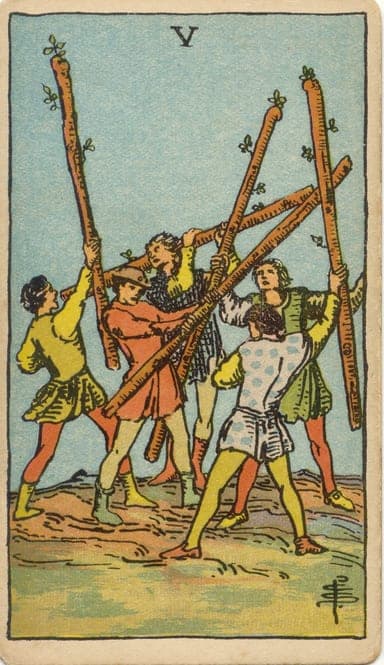
The Five of Wands is the card of five young men swinging staves at one another in open ground. Readers traditionally take it as competition, conflict and rivalry, and Waite calls it a mimic fight, strenuous but closer to sport than war.
- Suit
- Wands (Minor Arcana)
- Golden Dawn
- Saturn in Leo
- Upright
- competition, conflict, rivalry
- Reversed
- avoiding conflict, finding common ground
Upright
Nobody in this scene seems hurt. That detail shapes the reading: the card shows friction and competition, the noise of many people pushing their own ideas at once. Readers see brainstorming that turns into argument, a crowded market or a contest where everyone wants to be heard. Waite reads it as a sham battle, and the struggle can sharpen skills as much as it wears on nerves.
Reversed
Readers often take the reversed Five as the sparring dying down. People step back from the fight, look for common ground, or decide the argument is not worth having. Some readers also see it as conflict being avoided rather than settled, which leaves the question of what still needs saying.
In love and at work
Bickering over small things, or rivals for someone's attention, are the usual readings for a relationship. Among colleagues it points to a competitive team, clashing opinions in meetings or a crowded field of applicants. Readers use it to ask whether the contest is productive or just loud.
In the picture
Five youths in tunics of different colors, red, green, white and blue among them, raise their staves in a jumble of crossing lines. They stand on rough, uneven ground under a pale sky, and none of the staves lands a clear blow. The Golden Dawn gave this card to Saturn in Leo.
In a Caelumia profile
When Five of Wands comes up upright in a Caelumia reading, it counts toward these themes for that day, alongside the rest of the profile: Determination, Ambition.
Sources
- A. E. Waite, The Pictorial Key to the Tarot (1910). Waite's own guide to the deck he designed with Pamela Colman Smith, with each card's divinatory meanings.
- Hermetic Order of the Golden Dawn, Book T: The Tarot (1890s, published by Israel Regardie in The Golden Dawn (1937 to 1940)). The source of the planetary, zodiac and elemental attributions of the cards.
Updated September 28, 2026.
See it in your own profile
Caelumia reads your whole birth chart and your numbers together, and shows where they agree. Your profile is free to start, and your first results appear while you answer.