Three of Wands
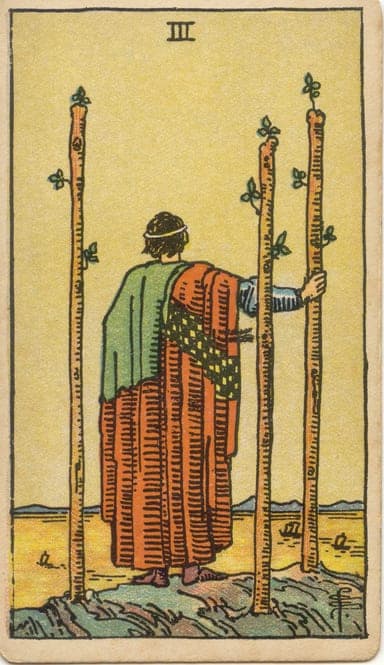
The Three of Wands is the card of someone watching ships go out from a high cliff. Readers traditionally take it as expansion and foresight, and Waite gives it established strength, enterprise and trade.
- Suit
- Wands (Minor Arcana)
- Golden Dawn
- Sun in Aries
- Upright
- expansion, foresight, looking ahead
- Reversed
- obstacles, delays, frustration
Upright
Ships already under sail give this card its mood. The work of planning is done and something has been sent out into the world, so readers see a stage of watching, waiting and looking ahead. It is associated with trade, travel and ventures that reach past home. The tone is steady confidence: the groundwork was laid, and the view from the ridge is wide.
Reversed
Obstacles, delays and frustration are the usual reversed reading. The ships seem stuck in harbor, or news from abroad is slow to arrive. Readers sometimes take it as a sign that the plan outran the preparation, and that some ground needs to be covered again before looking further out.
In love and at work
Distance is a frequent theme when readers apply it to love, including long-distance relationships or a partner who is away. For careers they link it to exporting, travel for work, or a project now out of your hands and in motion. It describes patience with something already launched, not a verdict on how it lands.
In the picture
Seen from behind, a figure in a red and green robe stands at the edge of a height, one hand on a planted wand. Two more wands stand beside him. Below stretches a yellow expanse of water where small ships pass, with hills beyond. The Golden Dawn gave this card to the Sun in Aries.
In a Caelumia profile
When Three of Wands comes up upright in a Caelumia reading, it counts toward these themes for that day, alongside the rest of the profile: Ambition, Adventure, Seeking.
Sources
- A. E. Waite, The Pictorial Key to the Tarot (1910). Waite's own guide to the deck he designed with Pamela Colman Smith, with each card's divinatory meanings.
- Hermetic Order of the Golden Dawn, Book T: The Tarot (1890s, published by Israel Regardie in The Golden Dawn (1937 to 1940)). The source of the planetary, zodiac and elemental attributions of the cards.
Updated September 28, 2026.
See it in your own profile
Caelumia reads your whole birth chart and your numbers together, and shows where they agree. Your profile is free to start, and your first results appear while you answer.