Page of Wands
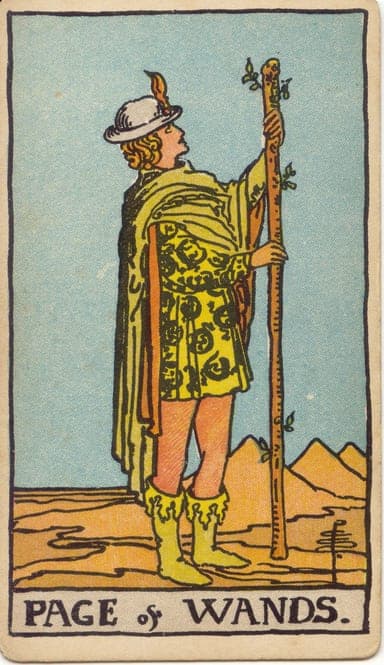
The Page of Wands is the youngest court card of the fire suit, a young man looking up at the top of his staff. Readers traditionally take it as curiosity, enthusiasm and exploration, and Waite gives him the role of a messenger or bearer of news.
- Suit
- Wands (Minor Arcana)
- Golden Dawn
- Fire (court card)
- Upright
- curiosity, enthusiasm, exploration
- Reversed
- impatience, scattered energy
Upright
Youthful fire tends to show up as questions, and this Page is full of them. Readers see an eager student or newcomer, someone keen to try things and ready to say yes. The card can stand for a person like that or for fresh news about a creative idea. Waite casts the Page as an envoy, so messages and announcements belong here too.
Reversed
Impatience and scattered energy are how readers take the reversed Page. Plenty of ideas get started and few get finished, or excitement fades before any real effort begins. It can describe someone restless and easily bored, and the card asks what would keep the interest going.
In love and at work
Flirting and the thrill of early attraction are common love readings. Around work it points to an internship, a new course, a creative pitch or a colleague full of enthusiasm and short on experience. Readers treat it as a good sign for exploring, without tying it to any particular outcome.
In the picture
A young man in a yellow tunic patterned with salamanders stands in a sandy landscape, holding a tall sprouting wand and gazing at its top. He wears a hat with a red feather. Behind him rise three pyramid-shaped mounds. In the Golden Dawn's scheme the court cards stand for fire rather than a single sign.
In a Caelumia profile
When Page of Wands comes up upright in a Caelumia reading, it counts toward these themes for that day, alongside the rest of the profile: Curiosity, Adventure.
Sources
- A. E. Waite, The Pictorial Key to the Tarot (1910). Waite's own guide to the deck he designed with Pamela Colman Smith, with each card's divinatory meanings.
- Hermetic Order of the Golden Dawn, Book T: The Tarot (1890s, published by Israel Regardie in The Golden Dawn (1937 to 1940)). The source of the planetary, zodiac and elemental attributions of the cards.
Updated September 28, 2026.
See it in your own profile
Caelumia reads your whole birth chart and your numbers together, and shows where they agree. Your profile is free to start, and your first results appear while you answer.