Three of Pentacles
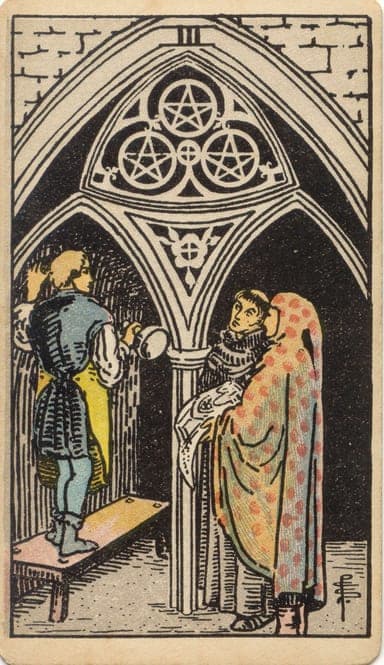
The Three of Pentacles is the card of skilled work done with others, set inside a church under construction. Readers traditionally take it as teamwork, craft and collaboration, and Waite gives it trade, skilled labor and the renown that good work can earn.
- Suit
- Pentacles (Minor Arcana)
- Golden Dawn
- Mars in Capricorn
- Upright
- teamwork, craft, collaboration
- Reversed
- disharmony, working alone
Upright
Craft improves when other people see it. This card is read as a meeting of skills: the maker, the planner and the patron each bring something the others lack. Waite links it to a trade or calling and to reputation earned through work. The Golden Dawn gave it Mars in Capricorn, energy put to disciplined use. Readers often draw it when a project needs honest feedback and shared plans.
Reversed
Plans get lost when nobody listens. Readers take the reversed three as disharmony on a team or a person working alone who might benefit from help. It can describe mismatched standards, unclear roles or the habit of refusing input. The card invites a look at who else belongs at the table.
In love and at work
Partners reading this card often look at how they build things together, such as a home, a budget or a shared routine. For careers, readers see apprenticeship, collaboration and recognition from people who know the craft. It points to work that improves with review. Whatever the outcome, the emphasis stays on process and cooperation.
In the picture
Inside a stone church, a young craftsman stands on a bench, working on the carved arch above him. Below, a monk and a figure in a patterned cloak hold up a sheet of plans and talk with him. Three pentacles are carved into the arch. The scene shows a building in progress, with the three people discussing the next step.
In a Caelumia profile
When Three of Pentacles comes up upright in a Caelumia reading, it counts toward these themes for that day, alongside the rest of the profile: Practicality, Sociability, Ambition.
Sources
- A. E. Waite, The Pictorial Key to the Tarot (1910). Waite's own guide to the deck he designed with Pamela Colman Smith, with each card's divinatory meanings.
- Hermetic Order of the Golden Dawn, Book T: The Tarot (1890s, published by Israel Regardie in The Golden Dawn (1937 to 1940)). The source of the planetary, zodiac and elemental attributions of the cards.
Updated September 28, 2026.
See it in your own profile
Caelumia reads your whole birth chart and your numbers together, and shows where they agree. Your profile is free to start, and your first results appear while you answer.