Two of Pentacles
The Two of Pentacles is the card of a young man keeping two coins in motion. Readers traditionally take it as balance and adaptability, the skill of juggling several priorities at once, and Waite adds gaiety, recreation and news that arrives in writing.
- Suit
- Pentacles (Minor Arcana)
- Golden Dawn
- Jupiter in Capricorn
- Upright
- balance, adaptability, juggling priorities
- Reversed
- overwhelm, disorganization
Upright
Keeping two things in the air takes a light touch. Readers see this card as flexibility in daily life: shifting money between needs, trading one commitment for another, staying loose enough to adjust. The Golden Dawn assigned it Jupiter in Capricorn, a pairing of expansion and structure. There is play in it too, and many readers stress that the juggler looks like he is enjoying himself.
Reversed
Too many balls and the rhythm breaks. In this position the card is read as overwhelm and disorganization, the point where juggling turns into dropping things. Readers often use it to ask which commitments could be set down, or which ones were never really needed.
In love and at work
Couples drawing this card are often asked how they share time between work, home and each other, since readers see it as a question of give and take. On the job it points to multitasking, shifting deadlines and a budget stretched in two directions. Readers treat it as a check on balance, not a verdict on how things turn out.
In the picture
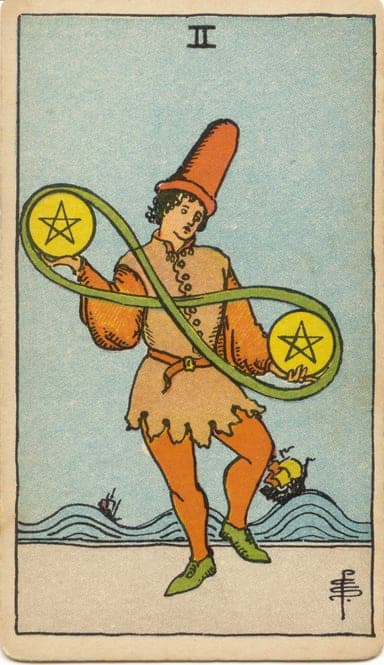
A young man in a tall red hat seems to dance as he holds two pentacles, joined by a green band that loops into a figure eight, the sign of infinity. Behind him two ships ride high, rolling waves. The contrast is the point readers usually notice: steady feet on the shore, a restless sea at his back.
In a Caelumia profile
When Two of Pentacles comes up upright in a Caelumia reading, it counts toward these themes for that day, alongside the rest of the profile: Practicality, Restlessness, Play.
Sources
- A. E. Waite, The Pictorial Key to the Tarot (1910). Waite's own guide to the deck he designed with Pamela Colman Smith, with each card's divinatory meanings.
- Hermetic Order of the Golden Dawn, Book T: The Tarot (1890s, published by Israel Regardie in The Golden Dawn (1937 to 1940)). The source of the planetary, zodiac and elemental attributions of the cards.
Updated September 28, 2026.
See it in your own profile
Caelumia reads your whole birth chart and your numbers together, and shows where they agree. Your profile is free to start, and your first results appear while you answer.