Ace of Pentacles
The Ace of Pentacles is the first card of the earth suit, a single golden coin offered from the clouds. Readers traditionally take it as a new opportunity and a solid start, and Waite gives it contentment and gold.
- Suit
- Pentacles (Minor Arcana)
- Golden Dawn
- The root of Earth
- Upright
- a new opportunity, abundance, a solid start
- Reversed
- a missed chance, poor planning
Upright
Earth begins here, in its purest form. The Golden Dawn called the ace the root of Earth, and readers treat it as a seed of material possibility: an offer, a resource or a practical opening that has not yet been planted. Waite ties it to contentment and to gold itself. Most readers frame it as a question about what could be built on firm ground, if someone takes the trouble to tend it.
Reversed
Turned upside down, the coin slips from the hand. Readers link this position to a missed chance or to poor planning, where a good start is left unattended. Waite points to the shadow side of wealth. The card is often read as a prompt to check foundations before counting on them.
In love and at work
Romance under this card is usually read as something steady taking root, such as a relationship built on shared routines and real care rather than grand gestures. For work and money, readers see a practical opening: a proposal, a first client or a skill worth investing in. What happens next is left to the person, and the card simply marks the beginning.
In the picture
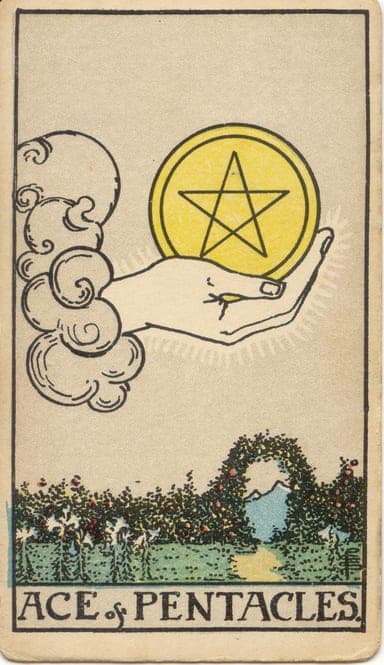
A hand reaches out of a gray cloud holding one large gold pentacle. Below it lies a tended garden full of white lilies, and a hedge of roses forms an arch. Through that opening a trail leads toward distant mountains. Smith gives the whole scene a calm, orderly feeling, a cultivated place with a way out into wider country.
In a Caelumia profile
When Ace of Pentacles comes up upright in a Caelumia reading, it counts toward these themes for that day, alongside the rest of the profile: Practicality, Stability.
Sources
- A. E. Waite, The Pictorial Key to the Tarot (1910). Waite's own guide to the deck he designed with Pamela Colman Smith, with each card's divinatory meanings.
- Hermetic Order of the Golden Dawn, Book T: The Tarot (1890s, published by Israel Regardie in The Golden Dawn (1937 to 1940)). The source of the planetary, zodiac and elemental attributions of the cards.
Updated September 28, 2026.
See it in your own profile
Caelumia reads your whole birth chart and your numbers together, and shows where they agree. Your profile is free to start, and your first results appear while you answer.