Ace of Swords
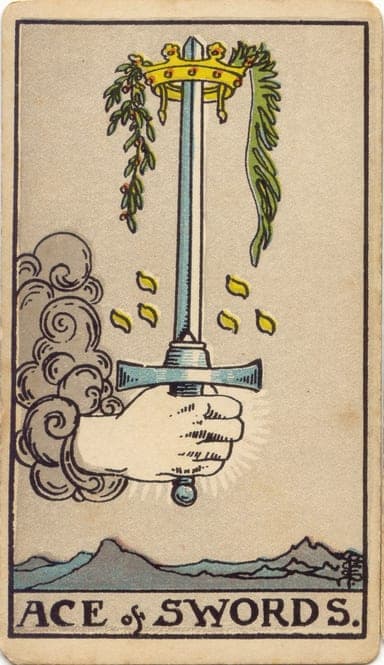
The Ace of Swords is the first card of the suit of air, a single sword held up by a hand from a cloud. Readers traditionally take it as clarity and a breakthrough: the moment a truth becomes plain and a confused situation can finally be cut through.
- Suit
- Swords (Minor Arcana)
- Golden Dawn
- The root of Air
- Upright
- clarity, a breakthrough, truth
- Reversed
- confusion, clouded judgment
Upright
A clean cut is the image most readers reach for. The ace stands for the mind at its sharpest, when facts line up and a decision that seemed impossible looks simple. Waite gives it triumph and conquest, and he adds that its force runs to excess in everything. Modern readers keep that edge in view: truth spoken plainly can clear the air, and it can also wound when it is used without care.
Reversed
Turned upside down, the sword points into fog. Readers take the reversed ace as confusion and clouded judgment: too many opinions, a fact misread, or a clever argument that goes nowhere. Waite keeps the same force but sends it toward bad results. The advice usually drawn is to wait for better information before acting.
In love and at work
Honest conversation is where readers place this card between partners, especially one that has been put off for a long time. It can mark the point where someone sees a relationship clearly, for better or worse. For a job or a project it is read as a strong idea, a clear plan, or the right words in a negotiation.
In the picture
Out of a gray cloud on the right, a hand grips a double-edged sword pointing straight up. A gold crown rings the tip, with an olive branch hanging from one side and a palm from the other. Small yellow flames fall through the air around the blade, and bare gray mountains lie below. The Golden Dawn calls this card the root of Air.
In a Caelumia profile
When Ace of Swords comes up upright in a Caelumia reading, it counts toward these themes for that day, alongside the rest of the profile: Analysis, Expressive communication, Curiosity.
Sources
- A. E. Waite, The Pictorial Key to the Tarot (1910). Waite's own guide to the deck he designed with Pamela Colman Smith, with each card's divinatory meanings.
- Hermetic Order of the Golden Dawn, Book T: The Tarot (1890s, published by Israel Regardie in The Golden Dawn (1937 to 1940)). The source of the planetary, zodiac and elemental attributions of the cards.
Updated September 28, 2026.
See it in your own profile
Caelumia reads your whole birth chart and your numbers together, and shows where they agree. Your profile is free to start, and your first results appear while you answer.