Six of Swords
The Six of Swords is a card of transition, drawn as a ferryman taking passengers across the water. Readers traditionally take it as leaving something behind and moving on, toward calmer ground, even when the crossing is a quiet and sad one.
- Suit
- Swords (Minor Arcana)
- Golden Dawn
- Mercury in Aquarius
- Upright
- transition, leaving behind, moving on
- Reversed
- unfinished business, resistance to change
Upright
Rough water on one side of the boat and smooth water on the other give readers the key image. The card stands for moving from a hard situation toward a steadier one, carrying what matters and leaving the rest. Waite gives it a passage by water, a route or an envoy. Readers often note that the mood is subdued rather than joyful, relief more than celebration.
Reversed
Stuck at the shore, the reversed card is read as unfinished business and resistance to change. Someone wants to leave but keeps turning back, or the move keeps being postponed. Waite gives it declaration and confession, so readers sometimes see something that needs saying before anyone can move on.
In love and at work
Moving on after a breakup, or a couple leaving a hard period behind together, is how readers apply it to love. Between colleagues it can mean a transfer, a job change or a project handed off. Readers treat it as a gradual shift, carried out one steady push at a time.
In the picture
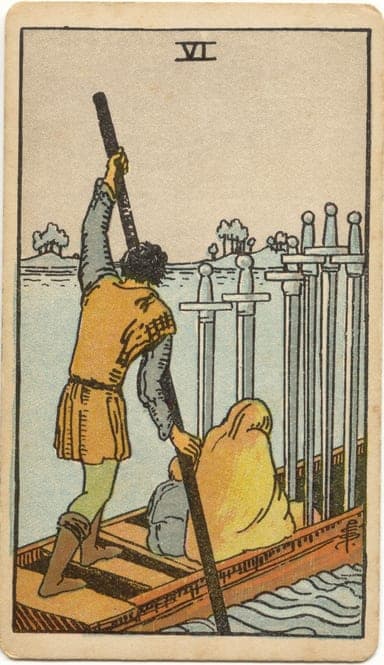
Standing at the back of a small boat, a ferryman pushes it along with a long pole. A hooded woman sits hunched in the middle with a child beside her. Six swords stand upright in the boat in front of them. The water on the right is choppy and the water ahead lies calm, with a far shore in view. The Golden Dawn gives it Mercury in Aquarius.
In a Caelumia profile
When Six of Swords comes up upright in a Caelumia reading, it counts toward these themes for that day, alongside the rest of the profile: Transformation, Restlessness.
Sources
- A. E. Waite, The Pictorial Key to the Tarot (1910). Waite's own guide to the deck he designed with Pamela Colman Smith, with each card's divinatory meanings.
- Hermetic Order of the Golden Dawn, Book T: The Tarot (1890s, published by Israel Regardie in The Golden Dawn (1937 to 1940)). The source of the planetary, zodiac and elemental attributions of the cards.
Updated September 28, 2026.
See it in your own profile
Caelumia reads your whole birth chart and your numbers together, and shows where they agree. Your profile is free to start, and your first results appear while you answer.