Ten of Swords
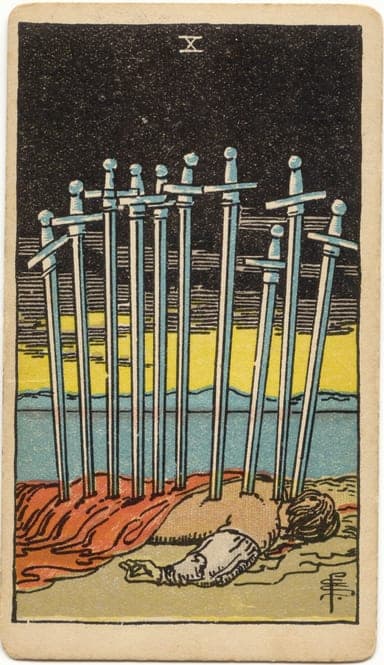
The Ten of Swords is the last numbered card of the suit, drawn as a figure lying face down with ten swords in their back. Readers traditionally take it as a painful ending and rock bottom, and as the release that comes once something is truly over.
- Suit
- Swords (Minor Arcana)
- Golden Dawn
- Sun in Gemini
- Upright
- a painful ending, rock bottom, release
- Reversed
- recovery, regeneration
Upright
Nothing further can go wrong in this scene, and that is the point most readers make. The card stands for an ending that is complete: a plan, a hope or a relationship that has run its course. Waite gives it pain, affliction, tears and sadness. Readers treat it as symbolic of a mental and emotional low, and they stress the release of no longer holding on.
Reversed
Getting back up is the reversed sense. Readers take it as recovery and regeneration, the slow return of energy after a hard end. Waite gives it advantage and profit that do not last, and readers sometimes read that as a caution against rushing to rebuild the same thing.
In love and at work
A relationship that has truly ended, and the relief of accepting it, is the usual reading for love. Readers use it to name exhaustion with a pattern rather than harm to anyone. At the office it can mean a project that has failed or a role that has run out, with room to start over.
In the picture
Under a black sky, a figure lies face down on the shore with ten swords standing in their back and a red cloth over their legs. Along the horizon a band of gold light breaks over calm water and distant hills. One hand, resting on the ground, makes a gesture often read as blessing. The Golden Dawn gives it the Sun in Gemini.
In a Caelumia profile
When Ten of Swords comes up upright in a Caelumia reading, it counts toward these themes for that day, alongside the rest of the profile: Transformation, Emotional depth.
Sources
- A. E. Waite, The Pictorial Key to the Tarot (1910). Waite's own guide to the deck he designed with Pamela Colman Smith, with each card's divinatory meanings.
- Hermetic Order of the Golden Dawn, Book T: The Tarot (1890s, published by Israel Regardie in The Golden Dawn (1937 to 1940)). The source of the planetary, zodiac and elemental attributions of the cards.
Updated September 28, 2026.
See it in your own profile
Caelumia reads your whole birth chart and your numbers together, and shows where they agree. Your profile is free to start, and your first results appear while you answer.