Five of Swords
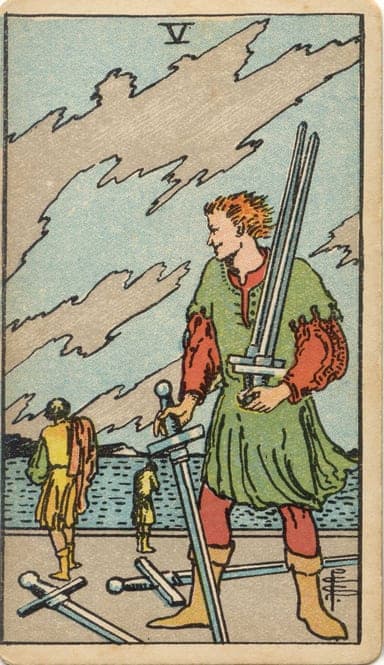
The Five of Swords is a card of conflict, drawn as a man gathering swords while two others walk away. Readers traditionally take it as defeat, or as a win that costs more than it gains, where being right leaves someone alone.
- Suit
- Swords (Minor Arcana)
- Golden Dawn
- Venus in Aquarius
- Upright
- conflict, defeat, winning at a cost
- Reversed
- reconciliation, making amends
Upright
Winning the argument and losing the room is the classic reading. The card points to a quarrel where someone came out ahead but left hurt feelings behind, or to a defeat that stings. Waite lists degradation and dishonor, and readers take the lesson as a question about what the fight was worth. Pride and point-scoring are the traps it names.
Reversed
After the dust settles, the reversed card is read as reconciliation and making amends. People put the swords down, apologize or at least stop keeping score. Waite gives the reversal much the same sense as upright, so some readers stay cautious and see an old conflict that still needs work.
In love and at work
Arguments that turn into contests are the usual reading between partners, where the goal becomes winning rather than understanding. In an office it can mean office politics, a hostile competitor, or a deal won by pressure that sours a working relationship. Readers often ask what a truce might look like.
In the picture
Smiling to himself, a young man in the foreground holds three swords and looks back at two figures walking away toward the water. Two more swords lie on the ground at his feet. One of the departing figures has his face in his hands. Ragged clouds streak across the sky. The Golden Dawn gives it Venus in Aquarius.
In a Caelumia profile
When Five of Swords comes up upright in a Caelumia reading, it counts toward these themes for that day, alongside the rest of the profile: Persuasion, Ambition, Independence.
Sources
- A. E. Waite, The Pictorial Key to the Tarot (1910). Waite's own guide to the deck he designed with Pamela Colman Smith, with each card's divinatory meanings.
- Hermetic Order of the Golden Dawn, Book T: The Tarot (1890s, published by Israel Regardie in The Golden Dawn (1937 to 1940)). The source of the planetary, zodiac and elemental attributions of the cards.
Updated September 28, 2026.
See it in your own profile
Caelumia reads your whole birth chart and your numbers together, and shows where they agree. Your profile is free to start, and your first results appear while you answer.