Four of Swords
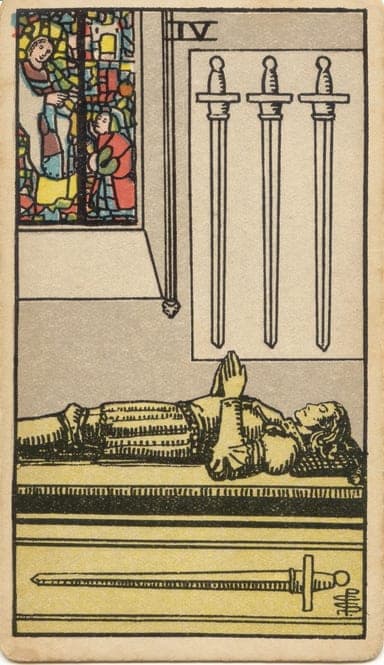
The Four of Swords is the card of rest, drawn as a knight lying still on a tomb in a quiet church. Readers traditionally take it as recovery and contemplation, a pause taken on purpose after strain, before any next step.
- Suit
- Swords (Minor Arcana)
- Golden Dawn
- Jupiter in Libra
- Upright
- rest, recovery, contemplation
- Reversed
- restlessness, burnout
Upright
Quiet after noise is the heart of this card. Readers see a time to step back, sleep, think, and let the mind settle before anything else. Waite gives it vigilance, retreat and solitude, and he calls it the repose of a hermit. Modern readers treat it as healthy withdrawal rather than defeat, a truce with oneself.
Reversed
Too little rest shows up when the figure is turned over. Readers read the reversal as restlessness and burnout: someone who cannot switch off, or who returns to the fight before they are ready. Waite gives it circumspection and careful management, a reminder that the pause has a purpose.
In love and at work
Space is what readers usually see a relationship needing under this card, time apart to think or simply a calmer season together. On the job it points to a break, a sabbatical or a slower week after a hard stretch. Some readers also take it as advice to plan quietly before speaking up.
In the picture
Carved in stone, a knight lies on top of a tomb with his hands pressed together in prayer. One sword runs along the side of the tomb, and three more hang point down on the wall above him. In the upper corner a stained glass window shows figures in color. The Golden Dawn gives it Jupiter in Libra.
In a Caelumia profile
When Four of Swords comes up upright in a Caelumia reading, it counts toward these themes for that day, alongside the rest of the profile: Steadiness, Solitude, Seeking.
Sources
- A. E. Waite, The Pictorial Key to the Tarot (1910). Waite's own guide to the deck he designed with Pamela Colman Smith, with each card's divinatory meanings.
- Hermetic Order of the Golden Dawn, Book T: The Tarot (1890s, published by Israel Regardie in The Golden Dawn (1937 to 1940)). The source of the planetary, zodiac and elemental attributions of the cards.
Updated September 28, 2026.
See it in your own profile
Caelumia reads your whole birth chart and your numbers together, and shows where they agree. Your profile is free to start, and your first results appear while you answer.