Knight of Swords
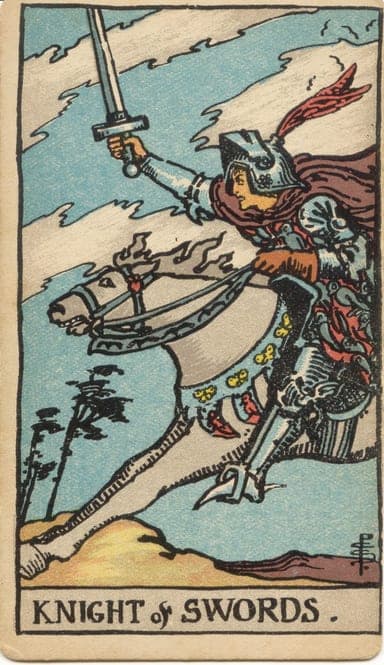
The Knight of Swords is the charging rider of the suit, drawn at full gallop with his sword raised. Readers traditionally take it as ambition, fast thinking and drive, the energy of someone who acts on an idea the moment it arrives.
- Suit
- Swords (Minor Arcana)
- Golden Dawn
- Air (court card)
- Upright
- ambition, fast thinking, drive
- Reversed
- recklessness, impatience
Upright
Speed defines this knight. Readers see a quick mind and a strong urge to act: someone who argues well, moves fast and heads straight for the goal. Waite gives him skill, bravery and capacity, and he reads the rider as a hero in battle. The same drive can run over people in its way, so readers weigh it against the spread.
Reversed
Charging in without looking is the reversed reading. Readers take it as recklessness and impatience: words said too fast, decisions rushed, a plan pushed through without listening. Waite gives it imprudence and incapacity. The usual advice is to slow down long enough to think.
In love and at work
Whirlwind romance or a partner who speaks before thinking are the classic readings for love. Readers note that the pace can feel thrilling or exhausting. For work the knight stands for fast progress, a bold pitch, or a colleague driving a project hard, with tempers sometimes running short along the way.
In the picture
Leaning forward in the saddle, an armored knight rides a white horse at a gallop with his sword held high. Clouds are torn across the sky and the trees bend sharply in the wind. Butterflies and birds decorate the horse's trappings. Everything in the picture seems to rush in one direction. The Golden Dawn gives the court cards of Swords to Air.
In a Caelumia profile
When Knight of Swords comes up upright in a Caelumia reading, it counts toward these themes for that day, alongside the rest of the profile: Restlessness, Ambition, Persuasion.
Sources
- A. E. Waite, The Pictorial Key to the Tarot (1910). Waite's own guide to the deck he designed with Pamela Colman Smith, with each card's divinatory meanings.
- Hermetic Order of the Golden Dawn, Book T: The Tarot (1890s, published by Israel Regardie in The Golden Dawn (1937 to 1940)). The source of the planetary, zodiac and elemental attributions of the cards.
Updated September 28, 2026.
See it in your own profile
Caelumia reads your whole birth chart and your numbers together, and shows where they agree. Your profile is free to start, and your first results appear while you answer.