Seven of Swords
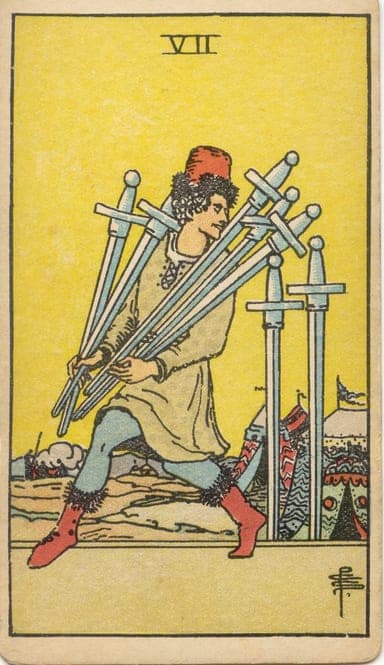
The Seven of Swords is a card of strategy and stealth, drawn as a man slipping away from a camp with an armful of swords. Readers traditionally take it as deception or getting away with something, and sometimes as a clever plan made alone.
- Suit
- Swords (Minor Arcana)
- Golden Dawn
- Moon in Aquarius
- Upright
- strategy, deception, getting away with something
- Reversed
- confession, conscience, coming clean
Upright
Sneaking off with more than your share is the plain image. Readers see strategy, cunning and a readiness to go around the rules, which can be resourceful or dishonest depending on the spread. Waite gives it design, attempt and hope, a plan still in motion. Many readers ask whether someone in the question is being less than open.
Reversed
Conscience catches up in the reversal. Readers take it as confession and coming clean: a secret shared, stolen goods returned, or someone deciding the scheme is not worth it. Waite gives it good advice and counsel, so it can also mean listening to someone who sees the plan more clearly.
In love and at work
Secrets, half-truths or keeping part of oneself hidden are the usual concerns when this card turns up for couples. Readers name it without accusing anyone. For work it can mean a competitor taking credit, a quiet side project, or a strategy that depends on others not noticing. It can also mean simply working smart.
In the picture
On tiptoe, a man carries five swords away from a camp of bright tents, glancing back over his shoulder. Two swords stay planted in the ground behind him. He wears a red cap and boots, and in the distance a few small figures stand near the tents. The sky is a flat yellow. The Golden Dawn gives it the Moon in Aquarius.
In a Caelumia profile
When Seven of Swords comes up upright in a Caelumia reading, it counts toward these themes for that day, alongside the rest of the profile: Persuasion, Independence, Analysis.
Sources
- A. E. Waite, The Pictorial Key to the Tarot (1910). Waite's own guide to the deck he designed with Pamela Colman Smith, with each card's divinatory meanings.
- Hermetic Order of the Golden Dawn, Book T: The Tarot (1890s, published by Israel Regardie in The Golden Dawn (1937 to 1940)). The source of the planetary, zodiac and elemental attributions of the cards.
Updated September 28, 2026.
See it in your own profile
Caelumia reads your whole birth chart and your numbers together, and shows where they agree. Your profile is free to start, and your first results appear while you answer.