Seven of Pentacles
The Seven of Pentacles is the card of a farmer pausing to look at his crop. Readers traditionally take it as patience, a long view and an investment of effort, and Waite connects it to money, business and barter.
- Suit
- Pentacles (Minor Arcana)
- Golden Dawn
- Saturn in Taurus
- Upright
- patience, a long view, investment
- Reversed
- impatience, little reward
Upright
Gardens grow on their own schedule. Readers see this card as the pause after hard work, when someone steps back and takes stock of what has been planted. It suits long projects, savings and anything that ripens slowly. The Golden Dawn gave it Saturn in Taurus, a patient and heavy combination. Waite ties it to business and exchange, and readers often use it to weigh whether to keep going.
Reversed
Waiting starts to feel like wasted time. Readers take the reversed seven as impatience or little reward for the effort so far, the frustration of a slow harvest. It can prompt a fair question: is the plan sound and simply slow, or does it need changing?
In love and at work
Slow growth in a relationship is how many readers take this card, a bond that deepens with steady attention rather than sudden sparks. With careers and money, they see long-term effort, investment and a moment to review progress. It points to patience as a theme for reflection, not to any promised return.
In the picture
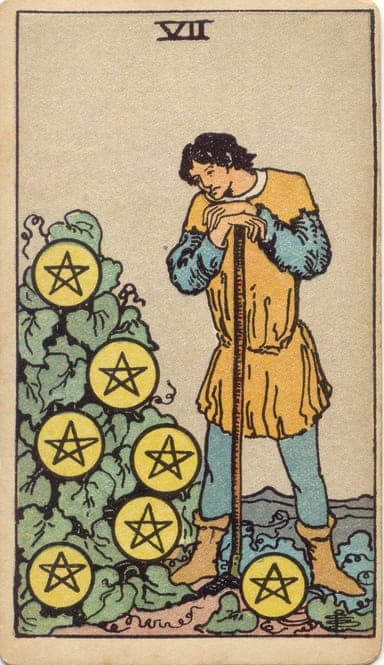
A young farmer leans on the handle of his hoe and gazes at a leafy green bush. Seven pentacles hang among the leaves like fruit, six on the plant and one at his feet. His face looks tired, thoughtful or both. Readers often debate which, since Smith left it open.
In a Caelumia profile
When Seven of Pentacles comes up upright in a Caelumia reading, it counts toward these themes for that day, alongside the rest of the profile: Steadiness, Determination.
Sources
- A. E. Waite, The Pictorial Key to the Tarot (1910). Waite's own guide to the deck he designed with Pamela Colman Smith, with each card's divinatory meanings.
- Hermetic Order of the Golden Dawn, Book T: The Tarot (1890s, published by Israel Regardie in The Golden Dawn (1937 to 1940)). The source of the planetary, zodiac and elemental attributions of the cards.
Updated September 28, 2026.
See it in your own profile
Caelumia reads your whole birth chart and your numbers together, and shows where they agree. Your profile is free to start, and your first results appear while you answer.