The two pillars
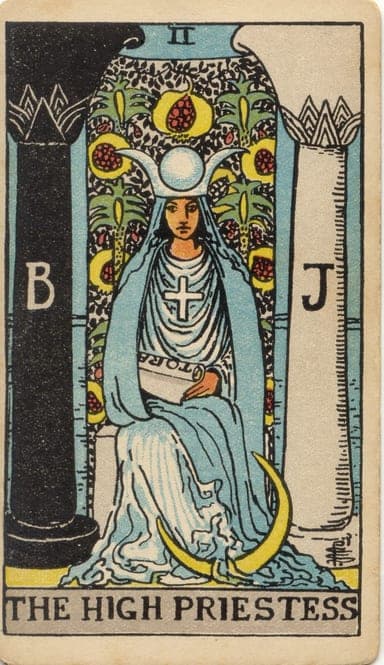
The black and white pillars behind the High Priestess are Boaz and Jachin, the two bronze pillars that stood at the porch of Solomon’s temple, marked B and J on the card.
In the tradition
The First Book of Kings describes two bronze pillars cast for the porch of Solomon’s temple, Jachin on the right and Boaz on the left, their capitals hung with rows of pomegranates. Nothing in the Bible says what they meant, and the names are usually translated "he establishes" and "in him is strength".
Freemasonry made the pair the threshold of its lodges in the 18th century, and the occult writers of the 19th read them as two opposed forces with the way between them. Waite drew on both. On his High Priestess the B pillar is black and the J pillar white, and she sits in the gap.
In the cards
Pillars come back on the Hierophant and on Justice, gray this time, framing a figure who holds a law. Readers often compare the three cards.
Sources
- A. E. Waite, The Pictorial Key to the Tarot (1910). Waite's own guide to the deck he designed with Pamela Colman Smith, with each card's divinatory meanings.
- Various, The Bible (King James Version 1611; the Latin Vulgate, 4th century). The source of much of the Temple, Eden and Revelation imagery in the Rider-Waite-Smith deck.
Updated October 9, 2026.
See it in your own profile
Caelumia reads your whole birth chart and your numbers together, and shows where they agree. Your profile is free to start, and your first results appear while you answer.